
Custom Power Device Development: Die Selection, Outline and Marking
Custom power device development: die selection with foundry partners, DFN/QFN/TOLL outline qualification, custom marking and packing for OEM programmes.
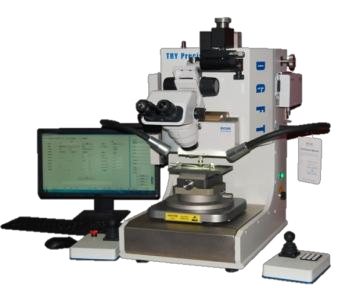
Custom device development means defining a part that does not exist in a catalogue: a specific RDS(on) and voltage class, a non-standard outline, or a private marking. OCENME develops custom power devices with foundry die selection, DFN/QFN/TOLL outline qualification and customer-approved marking, with R&D spending of CNY 10 million in 2024.
When this process applies
This page covers custom and private-label development for OEM and distribution programmes: die selection, package qualification, marking and packing. It does not cover wafer design from scratch, which requires a foundry design service, or module development.
Technical specifications
| R&D investment | CNY 10 million in 2024; 5.6% of revenue in 2023 |
|---|---|
| Development scope | IC design, application design, high and low voltage MOSFET, DFN/QFN outlines, custom products |
| Outlines qualified | PDFN 5×6, PDFN 3×3, TOLL4, TO-220F-2L, TO-220AB-2L and standard TO series |
| Marking | Customer part number, logo and date/lot code with approved marking drawing |
| Packing | Tape and reel, tube, tray; reel size and quantity per customer requirement |
| Documentation | Datasheet, marking drawing, packing specification, first-article record |
| Status | National High-Tech Enterprise; Shenzhen specialised and innovative SME |
Where it is the right choice
- OEM programmes that need a private part number and marking
- Applications where no catalogue part matches the voltage and RDS(on) window
- Distribution customers needing a specific reel size and label format
- Cost reduction on a mature design where the die can be re-sourced and re-qualified
Where it is the wrong choice
Stating this explicitly matters more than a capability list: if your part falls into one of these categories, another process will cost you less.
- Full custom wafer design from a blank mask set — that is a foundry design service
- Automotive programmes requiring AEC-Q101 and PPAP
- Development without a target volume; tooling and qualification cannot be amortised
- Requests to copy a competitor part number exactly without a functional specification
Equipment
- Lead frame design and tooling partners
- Package qualification lots on automated assembly lines
- Electrical characterisation bench for datasheet curves
- Reliability chambers for qualification stress
- Laser marking with programmable layouts
- Tape and reel with customer-specified pocket and pitch
Process questions
How long does a custom part take from requirement to production?
Die selection and datasheet definition are the fast part, weeks rather than months, when an existing foundry die fits. Package qualification with reliability stress is what sets the calendar: a new outline typically needs a qualification lot plus several hundred hours of stress before release. We give a dated plan after the requirement is fixed, not before.
What volume justifies a custom part?
The break-even is set by tooling and qualification cost divided by the price difference against a catalogue part. In practice, custom marking is viable at modest volume because it needs no tooling; a new outline needs annual volume in the millions to amortise. We show the arithmetic rather than quoting a threshold.
Can you build to our datasheet instead of yours?
Yes, if the limits in your datasheet are achievable and tested. We review each parameter against the die and package capability, flag any limit we cannot guarantee at 100% test, and either remove it or agree a sampling basis. Publishing a limit we cannot test is how suppliers end up in disputes.
Do we own the marking and part number?
Yes for private-label programmes, with a written agreement that the part number and marking belong to you and that we will not sell that configuration to another customer. The die and package process remain ours and our foundry partners’; a private label is not a transfer of die ownership.
Related capabilities and products
Semiconductor Packaging
Semiconductor packaging converts a bare die into a solderable, protected, electrically tested device. OCENME runs automated packaging lines in Shenzhen with 50 million units per month capacity, covering die attach, wire bonding, moulding, trim and form and 100% electrical test across TO-220, TO-252, TO-263, TO-247, PDFN and TOLL outlines..
View capabilityReliability Testing
Reliability testing establishes whether a packaged device survives the thermal, electrical and humidity stress of its application over time. OCENME runs nine test types in-house to JESD22 methods — HTRB, H3TRB, HT/HU, HTSL, temperature cycling, thermal shock, solderability, RSH and HPC — with X-ray, C-SAM and die shear capability for failure analysis..
View capabilityTraceability & Quality System
Traceability is the ability to walk from a device in a customer’s hand back to the wafer lot it came from, and forward from any wafer lot to every carton shipped. OCENME maintains that chain through ERP, MES and WMS records under an ISO 9001:2015 quality system, with lot codes marked on every unit and PCN notification before process or die source changes..
View capabilityKnowledge Base
Tolerance tables, cost mechanics and DFM rules written for buyers rather than engineers.
Read articlesSend the part number and the operating conditions
Tell us the voltage class, current, switching frequency and what the device is replacing. You will get a datasheet, a parameter comparison at matched conditions, and a quotation with MOQ and lead time.