
Bridge Rectifiers, 1 A to 50 A, Twelve Package Families
Single-phase bridge rectifiers from 1 A to 50 A in GBU, GBL, GBP, GBJ, KBJ, KBP, KBL, MSB, HBS, MBF, ABS and D3K packages, assembled in Shenzhen.
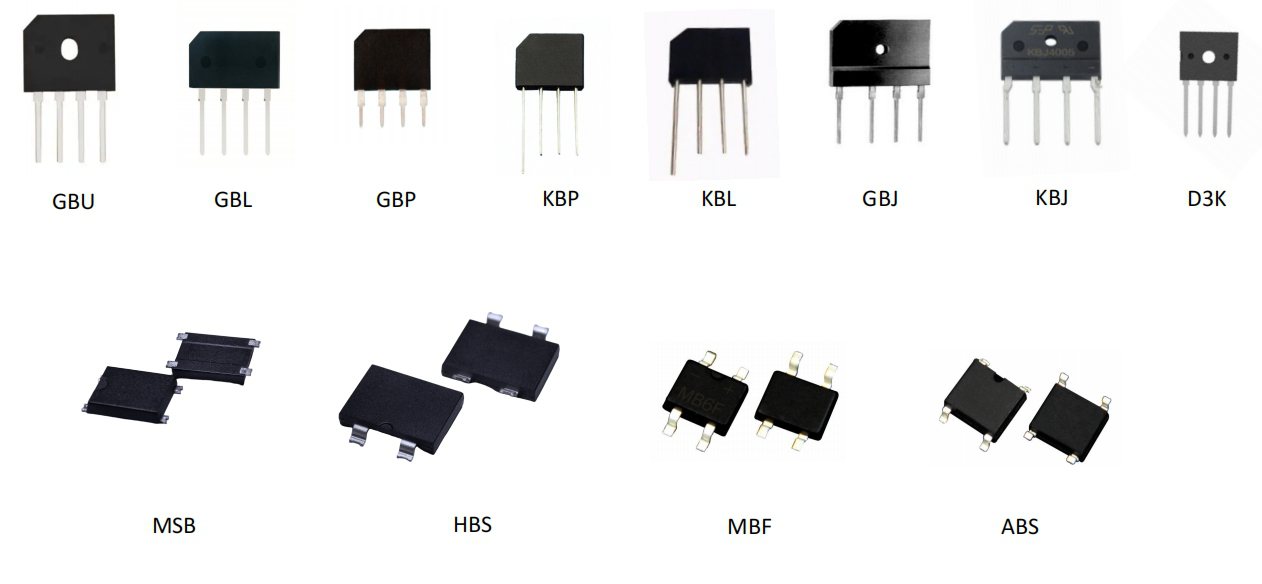
A bridge rectifier is four diodes arranged so both half-cycles of an AC input produce the same DC polarity, which makes it the first stage of almost every offline power supply. OCENME assembles single-phase bridges from 1 A to 50 A in twelve package families including GBU, GBJ, KBJ, KBP, MSB, HBS, MBF and ABS, with glass-passivated die and 100% forward-drop and reverse-leakage test.
Scope: what this product page covers
This page covers single-phase bridge rectifiers for AC/DC front ends up to 50 A, including in-line (KBP, KBL, MSB, HBS, MBF, ABS) and case-style (GBU, GBL, GBP, GBJ, KBJ, D3K) packages. Three-phase and avalanche bridges for telecom are quoted per project rather than stocked as catalogue parts.
Specifications
| Current class | 1 A, 2 A, 3 A, 4 A, 6 A, 8 A, 10 A, 15 A, 25 A, 35 A, 50 A |
|---|---|
| Voltage class | 400 V, 600 V, 800 V, 1000 V |
| Package families | GBU, GBL, GBP, GBJ, KBJ, KBP, KBL, D3K, MSB, HBS, MBF, ABS |
| Die construction | Glass-passivated junction (GPP) |
| Surge current | IFSM stated per current class in the datasheet |
| Mounting | Through-hole in-line, and case-mount with heatsink tab |
| Test | 100% forward drop and reverse leakage; isolation test on case-style bodies |
Materials
- Glass-passivated silicon diode die
- Copper or alloy lead frame with matte tin plating
- Epoxy encapsulation rated UL 94V-0
- Silicone or epoxy potting on case-style packages
Manufacturing process
- Die incoming GPP diode die inspected for glass passivation integrity before assembly.
- Assembly Four die soldered into the bridge configuration on the lead frame; orientation verified by first-article check each lot.
- Encapsulation Epoxy encapsulation or transfer moulding, cure, then marking with type and polarity.
- Test Forward drop across both diode pairs, reverse leakage on all four junctions, and an isolation test on case-style parts.
- Surge sampling IFSM tested on sampled units per lot and recorded against the lot number.
- Packing Tube, tray or bulk packing with anti-static protection; outgoing inspection on marking and lead straightness.
Bridge Rectifiers in production
Typical applications
- AC/DC front end of adapters and LED drivers below 50 W
- Battery charger input rectification
- Small appliance and power tool power supplies
- Industrial control transformer secondary rectification
- Instrument and metering power supplies
Quality and documentation
- All four junctions tested for reverse leakage at 100%, not just one diode of the bridge
- Isolation voltage tested on case-style packages, body to terminal
- Polarity and terminal marking verified at outgoing inspection
- IFSM sampling per lot with results recorded
- Bridge orientation is the most common assembly defect, so first-article check is mandatory per lot
What we do not do
We supply single-phase bridges as catalogue families; a specific ordering code is quoted with its datasheet rather than assumed from the family. Three-phase and avalanche bridges are not standard parts. We do not claim UL recognition of the package — if your product certification depends on a UL-recognised component, say so at RFQ stage, because substituting an unrecognised bridge after certification is a re-test, not a paperwork change.
Technical questions
How do I size a bridge rectifier for a capacitive input filter?
Size on surge and thermal current, not average DC output. With a capacitor input filter the diodes conduct in short, high-amplitude pulses, so RMS current through the bridge is roughly 1.8 to 2.5 times the DC output current and junction heating follows the RMS value. A 2 A bridge feeding a 1 A DC load is usually at its limit, not comfortably inside it.
Which bridge package should I choose for a 12 W adapter?
For 12 W at universal input, a 1 A in-line package such as MBF or ABS is normally enough and costs least. Move to a 2 A or 3 A class if the adapter runs in a sealed enclosure above 40 °C ambient, because package thermal resistance — not the current rating — sets the real limit inside a closed plastic case.
Do you supply bridges with a specified reverse recovery time?
Standard mains-frequency bridges are not characterised for Trr because they switch at 50 or 60 Hz. If your topology puts the bridge in a high-frequency path, you need a fast-recovery bridge, which is a different die and a different ordering code. Tell us the switching frequency at RFQ.
Can you mark our part number on the bridge?
Yes, at production volume with a marking approval step: you approve the marking drawing, we build a sample lot, you sign off, then volume starts. A marking change is a documented change with a first-article record, because wrong marking on a bridge is a traceability failure rather than a cosmetic one.
Adjacent products and capabilities
Low & Medium Voltage MOSFETs
A low voltage power MOSFET is an N-channel switching device used below 200 V, where conduction loss dominates and on-resistance decides efficiency. OCENME supplies 30 V to 200 V trench and shielded-gate (SGT) MOSFETs from 1.6 mΩ on-resistance and 220 A continuous drain current, in TO-220, TO-252, TO-263, TO-262 and PDFN 5×6 packages, packaged in Shenzhen at 50 million units per month..
View productSiC Schottky Diodes
A SiC Schottky barrier diode is a majority-carrier rectifier with no minority-carrier reverse recovery, used where a silicon fast recovery diode would waste switching energy. OCENME supplies a 650 V, 20 A SiC Schottky family with 1.34 V forward drop, 130 A surge current and a 175 °C junction rating, in TO-220AC, TO-220FAC and TO-247 outlines..
View productFast Recovery Diodes
A fast recovery diode is a PN rectifier engineered for short reverse recovery, so it can freewheel in a switching converter without dominating turn-on loss in the opposing switch. OCENME supplies fast recovery diodes from 200 V to 1500 V in TO-220, TO-247, TO-3P, TO-252 and TO-263 packages, with Trr and IFSM stated per ordering code in the datasheet..
View productQuality & Inspection
CMM inspection to ±0.002 mm, FAI reports and PPAP documentation for every order.
Inspection capabilitySend the part number and the operating conditions
Tell us the voltage class, current, switching frequency and what the device is replacing. You will get a datasheet, a parameter comparison at matched conditions, and a quotation with MOQ and lead time.